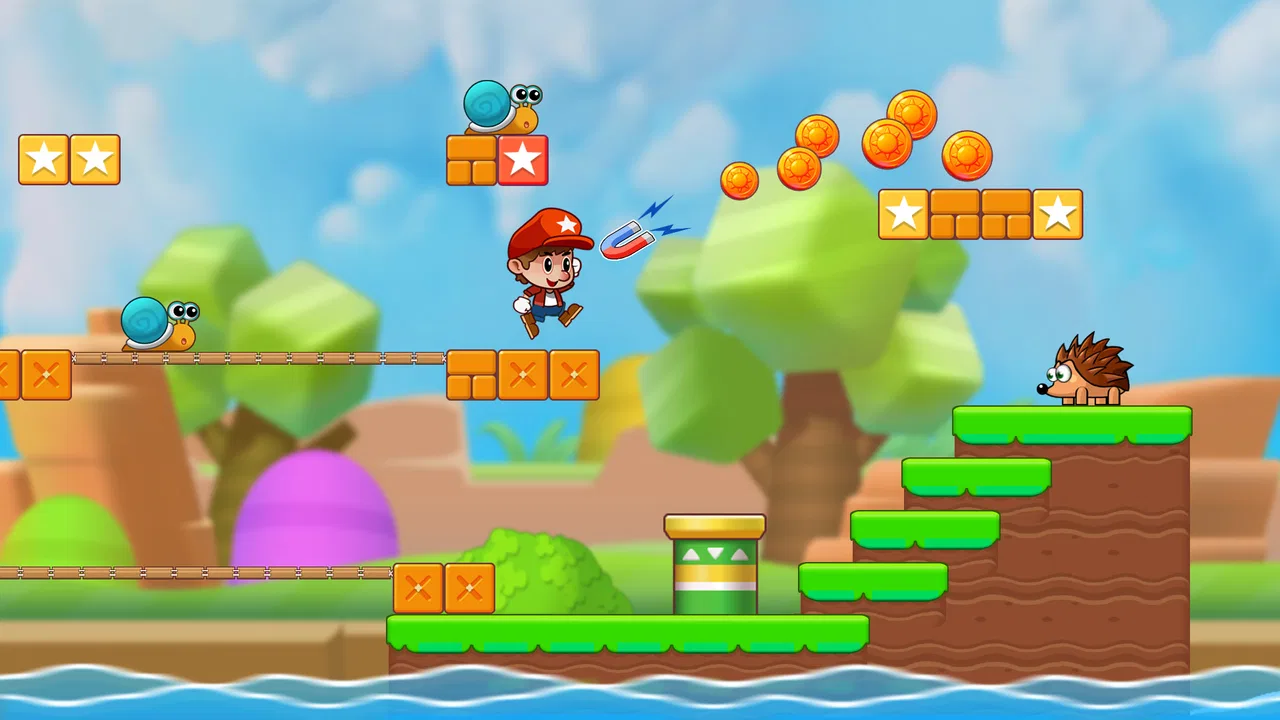
Super Billy Bros - Jump & Run
- 4.5
- Rating
- 5.00M
- Installs
- Free
- Price

 Analysis by App-foxy
When I first played Super Billy Bros - Jump & Run, I approached it as a quick adventure game rather than a long-form platforming challenge. That expectation matters, because its appeal comes from the familiar rhythm of moving through dangerous stages, collecting useful items, and trying to reach the rescue goal without losing momentum. It is easy to understand within a few minutes, but the timing required by a jump-and-run game can make the experience much less casual once obstacles begin demanding faster reactions.
The game is developed by BIT GAME and is available free of charge, with optional in-app purchases priced from $1.99 to $9.99 per item. It is listed for Teen players and runs on Android devices using version 5.0 or later. I see it as a compact choice for people who enjoy classic adventure platformers but want something they can open for a short session rather than commit to a large role-playing game.
How Super Billy Bros handles readability and navigation
The clearest part of the experience is its basic objective. You guide Billy through platforming sections, collect coins, stars, and mushrooms, and work toward rescuing the Princess from monsters. That structure gives each stage an immediately understandable purpose. I never felt lost about the overall goal, which is important on a small phone screen where complicated menus or layered instructions would quickly become tiring.
You May Also Like

 Blood Strike: 2.5 Anniversary
Blood Strike’s Loadouts Turn Every Drop Into a Tactical Gamble
A close look at Blood Strike’s custom loadouts: how fast access to signature weapons reshapes its battle royale rhythm, rewards preparation, and narrows the gap between fights.

 Pandora - Music & Podcasts
Pandora’s Music Is Easy to Start, but Harder to Recover
Pandora’s strength is its low-effort path from a seed to a station. Its weak spot is how much confidence it asks you to place in connection, setup, and quiet recovery.

 8 Ball Pool
 Is Built on Rivalries, Rematches, and Routine
A close look at the rivalries, rematches, shared routines, and unanswered safety questions that turn a quick pool match into a persistent mobile community.

 Samsung Music
’s Quiet Strength Is Playing What You Already Own
Its reach comes less from spectacle than from dependable access to a personal library. That simplicity is both the app’s strongest retention engine and its ceiling.

 AccuWeather: Weather Radar
AccuWeather Review: A Quick, Clear Forecast for Everyday Decisions
For everyday plans, the best forecast is the one you can understand quickly. AccuWeather makes rain timing, radar, and local conditions easy to act on, with a few trade-offs.

 Hill Climb Racing
Why Hill Climb Racing Still Turns Crashes Into One More Run
A tiny car, a bumpy hill and one more upgrade: Hill Climb Racing keeps resurfacing because its simple chaos makes every near-miss feel personal.
More From Our News Desk



The familiar collection system also helps with orientation. Coins naturally encourage exploration, while stars and mushrooms give players additional things to notice as they move through a level. I found that this creates two ways to play: I could focus on reaching the end safely, or slow down and inspect the route for more collectibles. That choice makes the game more approachable for someone who is still learning the controls, because success does not have to mean chasing every item on the first attempt.
Navigation is easiest when I treat the screen as a sequence of small decisions rather than one continuous sprint. Before moving quickly, I look for the next safe landing area and decide whether a collectible is worth the extra risk. This is a useful habit for younger players and for anyone who finds rapid visual scanning difficult. The game’s straightforward adventure format supports that approach better than a platformer filled with branching menus, inventory screens, or complicated character statistics.
At the same time, the visual language of a jump-and-run game can become busy during active play. A player has to separate the character, platforms, enemies, gaps, and collectible objects while also judging movement timing. I found that readability depends heavily on concentration. Someone with reduced visual attention may understand the goal but still struggle to process everything quickly enough during a jump.
The game is therefore more readable at the level of purpose than at the level of moment-to-moment action. The destination and collection goals are clear, but the player still needs to interpret a moving scene under pressure. That distinction is worth keeping in mind if you are choosing it for a child, an older relative, or anyone who prefers slower interfaces.
What the collection objectives add
Coins, stars, and mushrooms are not merely decorative targets in the way I experienced the game. They give the player a reason to look beyond the safest direct route. A cautious player can ignore optional pickups and concentrate on surviving, while a more confident player can use them to turn a familiar stage into a replay challenge. This makes the game less one-dimensional than a simple “reach the finish” format.
My practical advice is to separate learning from collecting. On an early attempt, I would watch the route and learn where the dangerous sections are. On later attempts, I would return for the items that require more deliberate movement. This reduces frustration and makes the objectives easier to understand, especially for players who need time to build visual and motor familiarity.
That approach also reveals one of the game’s trade-offs: the same collectibles that add replay value can increase pressure. If you feel compelled to gather everything, a relaxed adventure can quickly become a test of precision. Players who prefer a calm, low-demand experience may enjoy the scenery and basic progression more if they give themselves permission to leave some items behind.
Motor and sensory considerations during play
The main accessibility challenge is physical timing. Jump-and-run games ask for repeated taps or directional actions at the right moment, and mistakes usually come from acting too early, too late, or while trying to adjust position in the air. I found that the game rewards short, deliberate inputs more than frantic tapping. Holding a steady rhythm is generally more useful than reacting emotionally when an obstacle appears.
This matters for players with limited dexterity, hand tremors, slower reaction times, or fatigue. The game may be enjoyable in brief sessions, but its demands can become uncomfortable if a player has to repeat the same difficult section many times. I would recommend testing it with the phone supported on a table or held in a stable position, rather than playing one-handed while walking or standing. That simple change makes the controls easier to manage and reduces accidental movement.
For children, the game can be a good exercise in visual-motor coordination, but I would not assume that its simplicity makes it effortless. A child may understand exactly what to do and still need several attempts to coordinate movement and jumping. Encouraging them to learn one section at a time works better than urging them to rush toward the Princess.
Sensory comfort is more difficult to judge universally because people respond differently to animated movement, bright game imagery, and repeated action. I found the experience most comfortable when I played with the screen at a moderate brightness and took breaks between attempts. Anyone sensitive to motion or visual clutter should begin with a short session and see how the pace feels before settling in for longer play.
Audio can also affect comfort, even when the visual design is understandable. I usually play mobile games with the sound lowered when I am in a shared space or when I want to concentrate on timing without extra stimulation. That is especially practical on public transport, in a waiting room, or near someone who is sleeping. The game is better suited to controlled surroundings than to a noisy environment where attention is already divided.
A realistic everyday play session
Imagine having ten minutes before an appointment. This is where I think the game fits naturally. I can open it, play a few attempts, and stop without needing to remember a complicated story or rebuild a large strategy. The clear rescue objective makes it easy to return after a break, while the collectible system gives me an optional reason to replay a section instead of simply repeating it without purpose.
That same scenario exposes a limitation. If I am interrupted during a demanding sequence, returning my attention to the exact timing can take a moment. It is not the best choice when I need a game that can be played with half my focus while handling messages or conversation. For those situations, a turn-based puzzle game or a slower adventure would be more forgiving.
Situational access on different phones and in different environments
Because the game supports Android 5.0 and later, it is available to people using older compatible devices as well as newer phones. That can be valuable for families sharing an older handset or for players who do not upgrade frequently. However, software compatibility alone does not guarantee a comfortable experience. Screen size, touch responsiveness, battery condition, and the physical condition of the device can all affect how manageable the controls feel.
On a larger phone, the action is easier for me to inspect because the character and nearby hazards have more visual space. On a smaller screen, I need to pay closer attention and may feel more pressure during quick sequences. A player with low vision might prefer the largest practical display available, while someone who relies on a compact phone should expect to spend more time learning the visual cues.
The game also works better when the device is stable. I would avoid playing while walking, riding a bicycle, or standing on a crowded train. Those situations introduce movement that has nothing to do with the game and make precise jumps unnecessarily difficult. Sitting down with both hands available is a small but meaningful adjustment for players who need more control.
For shared family use, the Teen content rating is an important part of the decision. I would still look at the game together with a younger player rather than assuming that a simple cartoon-style adventure is automatically suitable for every child. The rating gives parents a useful starting point, while the child’s own tolerance for challenge, repeated failure, and animated conflict should guide the final choice.
The free entry point makes it easy to try without paying first. That is helpful when you are unsure whether the control style will suit your hands or eyes. The optional purchases should still be treated carefully, particularly on a shared device. In my view, the sensible approach is to play the free experience long enough to decide whether the core movement feels comfortable before considering any extra spending.
Who benefits most from this format
I would recommend it to players who enjoy recognizable platforming goals, short attempts, and the satisfaction of improving through repetition. It is also a reasonable pick for someone who wants a lightweight adventure game rather than a story-heavy title with extensive dialogue. The straightforward objective makes it easy to explain to a friend: move through the stage, collect what you can, avoid monsters, and keep working toward the rescue.
It is less suitable for players who need adjustable difficulty, very slow pacing, or extensive control customization. A person with limited hand mobility may find the required timing too demanding, especially if there is no alternative control method that fits their needs. Similarly, anyone looking for deep character development, exploration without time pressure, or a peaceful game should probably choose a different type of adventure.
Compared with a typical puzzle game, this one asks more from reaction speed and coordination but less from planning several moves ahead. Compared with a large platforming game on a console, it is easier to pick up and play but offers a more compact experience. Compared with an idle adventure title, it requires active attention throughout the important moments. Those differences are more useful than simply calling it “fun,” because they show exactly where it belongs in a mobile library.
Remaining barriers and practical ways to reduce them
The biggest barrier is the relationship between failure and repetition. Replaying a section can be satisfying when I know I am improving, but it can feel discouraging when a small timing error sends me back through familiar content. Players with motor limitations may experience that repetition as a physical burden rather than a motivating challenge. Short sessions, frequent breaks, and focusing on one objective at a time can make the experience more sustainable.
Another barrier is divided attention. The game is not ideal for playing while talking, commuting through a crowded area, or supervising another task. A player who needs to pause often may lose the rhythm needed for successful movement. I would reserve it for moments when I can give the screen my full attention, even if that only lasts a few minutes.
There is also a difference between understanding the game and being able to perform well in it. Clear goals help with cognitive access, but they do not remove the need for quick physical responses. That is why I would not describe it as universally accessible simply because the rules are easy to grasp. Its strongest inclusive quality is its approachable structure, while its weakest point is the precision demanded by active platforming.
The Teen rating may also narrow its audience in households where parents want a game designed specifically for younger children. Even if a child understands the collection goals, guardians should decide whether the content and challenge level fit that child. For older players, the same rating is unlikely to be a problem, but the speed and repeated attempts may still matter more than the label.
Finally, optional purchases can create a boundary for players who want an entirely cost-free experience. The game itself is free to start, but the presence of items priced between $1.99 and $9.99 means families should use the usual device safeguards and agree on spending rules. I see this less as a reason to reject the game and more as something to manage before handing it to a child.
My inclusive verdict after playing
Super Billy Bros - Jump & Run works best as a familiar, immediately understandable mobile adventure with optional collection goals. Its clear rescue premise, compact sessions, and free starting point make it easy to try. The strong public response is reflected in its 4.5 average from around 64 thousand ratings, and its reach extends to over 5 million installs. Those figures suggest that the format has found a broad audience, although popularity does not remove the physical demands of the controls.
The current version is 1.7.9.185, and the game comes from BIT GAME. I would choose it for a friend who enjoys classic platforming, likes improving through repeated attempts, and can comfortably manage touch-based timing. I would not choose it for someone who needs slow, interruption-friendly play, extensive accessibility controls, or a low-stimulation experience.
The most important practical point is that clear rules do not equal effortless access. The game communicates its main purpose well, and its coins, stars, and mushrooms give players control over how much of each stage they want to pursue. But success still depends on visual tracking, stable device handling, and repeated motor responses. Playing while seated, lowering distractions, learning the route before hunting collectibles, and taking breaks are the adjustments I found most useful.
My final view is positive but specific: this is a good free adventure platformer for focused short sessions, not a universal recommendation for every ability or context. If you enjoy the satisfaction of making one more accurate jump than you managed before, it has a friendly and accessible starting point. If timing-heavy play is tiring or uncomfortable, a slower alternative will serve you better, even though this game’s simple goals may still be easy to understand.
FAQs for Super Billy Bros - Jump & Run
01What is Super Billy Bros - Jump & Run about?
Super Billy Bros - Jump & Run is a thrilling platformer game that takes players on an adventure through vibrant worlds filled with challenging obstacles, hidden secrets, and formidable enemies. Players control Billy as he navigates through levels, collecting coins and power-ups, to defeat bosses and rescue his friends.
02Is Super Billy Bros - Jump & Run free to play?
Yes, Super Billy Bros - Jump & Run is free to download and play. However, it offers in-app purchases for players who wish to enhance their gaming experience with additional items, skins, or power-ups. These purchases are optional and not necessary to enjoy the full game.
03What platforms is Super Billy Bros - Jump & Run available on?
Super Billy Bros - Jump & Run is available for both Android and iOS devices. You can download it from the Google Play Store for Android devices or the Apple App Store for iOS devices. Make sure your device meets the required specifications for the best gaming experience.
04Does Super Billy Bros - Jump & Run require an internet connection?
No, Super Billy Bros - Jump & Run does not require a constant internet connection to play. You can enjoy the game offline once it is downloaded. However, an internet connection may be needed for certain features like updates or in-app purchases.
05Is Super Billy Bros - Jump & Run suitable for children?
Super Billy Bros - Jump & Run is designed to be family-friendly, with colorful graphics and simple controls. The gameplay is suitable for children, but parents should be aware of optional in-app purchases and ensure that appropriate settings are enabled to prevent unauthorized purchases.
Pros
- Engaging levels with varied challenges.
- Responsive controls enhance gameplay.
- Attractive and colorful graphics.
- Regular updates with new content.
- Offline play mode available.
Cons
- In-app purchases can be expensive.
- Occasional ads interrupt gameplay.
- Limited character customization options.
- Some levels feel too similar.
- Requires frequent updates for new features.

Super Billy Bros - Jump & Run
Gallery